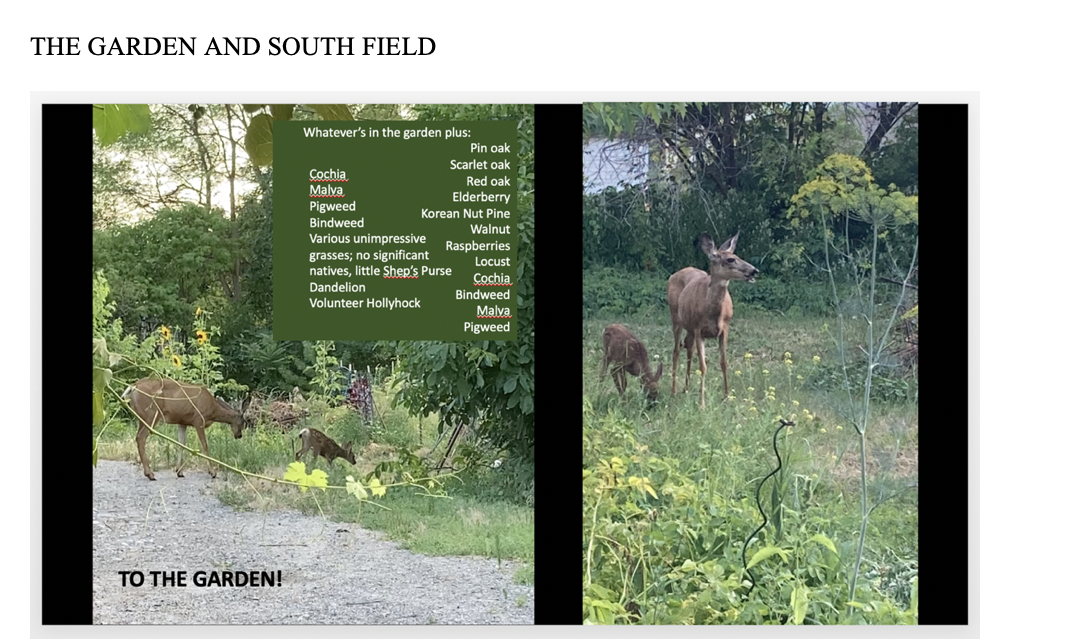
It’s common to encounter deer at the spot on the driveway shown in the left photo above. We all walk through that spot to get to the garden. The first thing a solitary doe does when we cross paths is check for where its fawn is. They have a tell. They look immediately in the direction they think their fawn may be, and then they fasten their ears that way, too, or wiggle them around until they get a lock on the fawn’s location. I just wait until they decide how they need to handle our impasse. Sometimes I step back and the fawn will come join its doe, other times, like in this video, the doe yields to me, admittedly with a bit of a cervidae eye roll. I interpreted it as “go ahead, fool.” Sound up. Don’t even try to tell me deer do not have personalities. The doe in the vid often acts like this, very confident in her choices and actions.
Met this doe when we were both trying to cross the driveway one morning.
In the collage below, the two photos marked with a six show the location of the main garden. Other pics sample what’s growing there. Soooo, clockwise from left: 1) location inset map, 2) unfenced potato and garlic rows, 3) example of white row cover, 4) outside of the south end of main plot, 5) clover planted between garden rows for soil building, 6) bee on marigold, 7) first full size acorns appear on oak tree in 2022, 8) cat and early volunteer potatoes, 9) barrow of weeds and Sweet Williams, 10) garden and field paths.
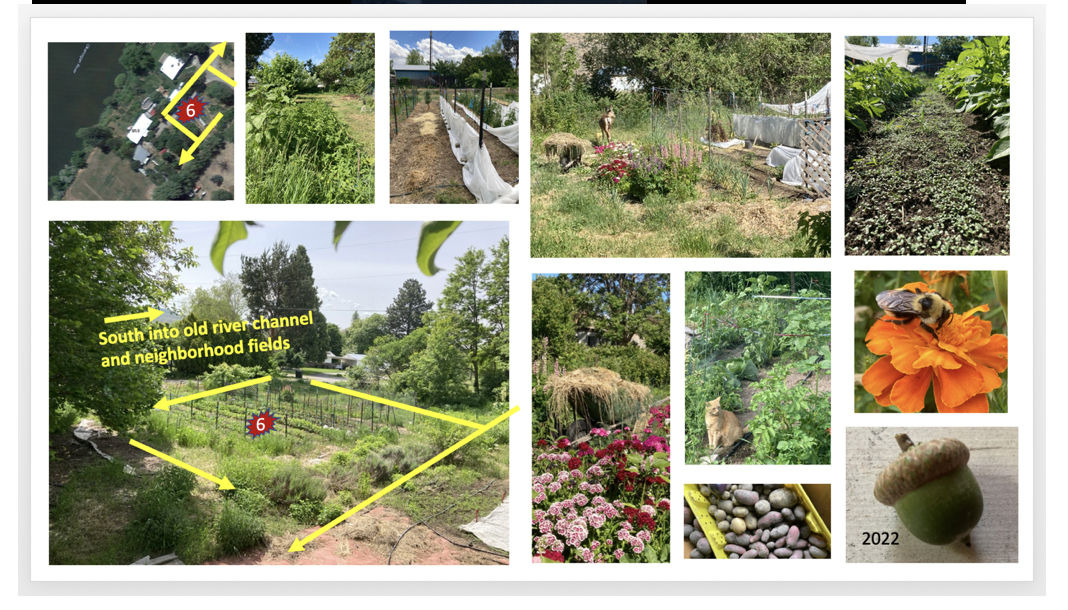
The garden and field area is a busy spot with the deer (and me) regularly passing through it on all sides, but because there’s so much other good forage on the property, and because the deer population pressure is low enough, I’ve had few problems protecting a garden from deer so far. For all but the last three or four years, I’ve gardened here with no fencing at all, but when the deer started showing up regularly, I did put some deterrents in place. It started with using row cover on plants they were most interested in. (Photo above) It hides the plants and flutters around with even slight breezes. The strategy there is just “out of sight, out of mind.” It worked fine, but opening and closing it daily all season long grew annoying, so the second year, I started incorporating “permeable” fencing in a variety of ways. The goal was just to make the garden less appealing.

Using Partial Fencing
There are multiple food growing plots here: the annual garden in the field, two blueberry plots, a strawberry bed, 7 fruit trees, a couple walnut and almond trees, kiwi vines, and grape vines in multiple locations. The annual garden also has multiple plots: 1) a main plot that has permeable fencing, 2) a smaller plot with “inconvenience fencing,” and 3) an experimental totally not fenced couple rows of potatoes and garlic.
The “main” garden has its entire perimeter fenced to different degrees and a spot on the east fence line where you just pull the fence apart to enter. No lock, no latch. Probably 40 feet x 40-ish. There are different levels of permeability around the perimeter, part strategy, part just taking the easy way. The picture above shows a section of fencing that could be easily jumped by an adult deer or ducked under by a fawn (south fence line). It’s still worked for me. The does don’t seem much tempted to breech fences here, not with all the food available outside a fence. But occasionally, the fawns would notice the trickery and push a hole through somewhere. The few times it happened, I shoved something in their hole— a roll of fencing, a pile of weeds I’d pulled up, anything at hand— and then watch to see if I needed to do something more serious.
The west fence line (where the doe is headed, left, above) has the least permeable fencing, i.e. the fullest barrier, because I had some six foot tall stuff. I used it on this line because it’s the start of the path to the paddocks, which they use frequently.
North side of the garden fence is just 4 foot tall, 4 inch hog wire type fencing tied to T-posts. Actually, it’s lightweight rebar. I think it’s used in horizontal concrete, like slabs. It comes in six foot long sections which makes it easy to move around as needed. There’s a path along the outside, but it’s not as well used by the deer as other ways through the field.
Spot Fencing (customized to plants)
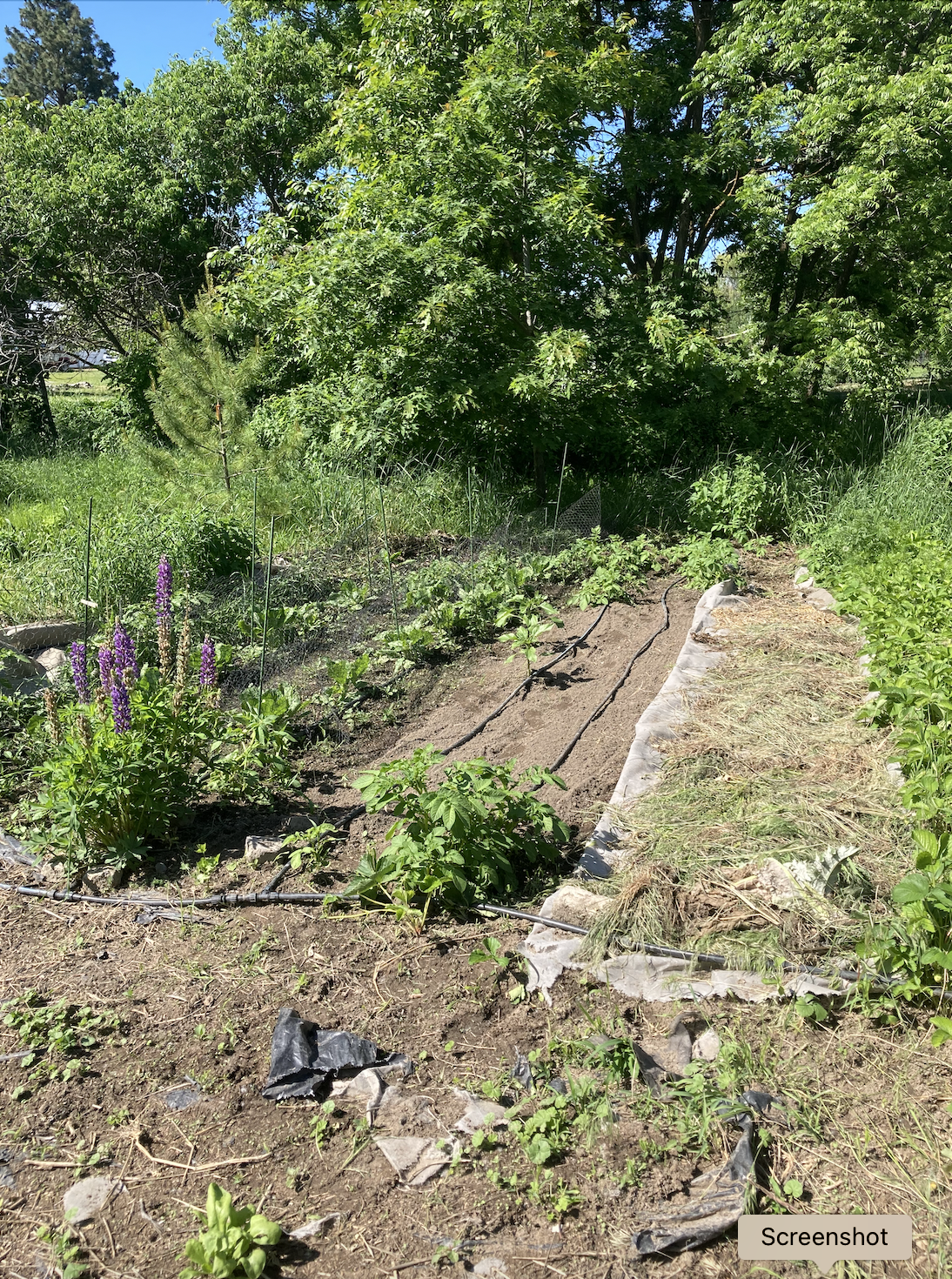
In the small garden plot next to the main garden, a small carrot plot provides another example of permeable fencing, quick, easy, customizable to the plants it’s protecting. Here, it’s just a 12 foot double row needing some deterrent. I had some 24 inch chicken wire that I ran up both sides of the row and staked into place with a couple stakes that ran through each side (think triangle). So it was mostly closed but not securely. The deer could easily have stomped it in or pushed the tops open, but they didn’t and part of that has to do with how I used some other plants in that spot. In the photo below, the bare spot is where carrots have just been planted. The triangle of chicken wire will be set over them soon. To the right of the bare spot, you see a swath of weed barrier and the edge of a large strawberry patch. It’s genuinely there to suppress weeds, but once the little carrot fence is up, it’ll also offer the deer a clear and non-destructive path through that section of the field. I’ve been surprised the deer don’t eat the strawberry plants. They seem similar to raspberry leaves, which they love.
Using Plants Strategically
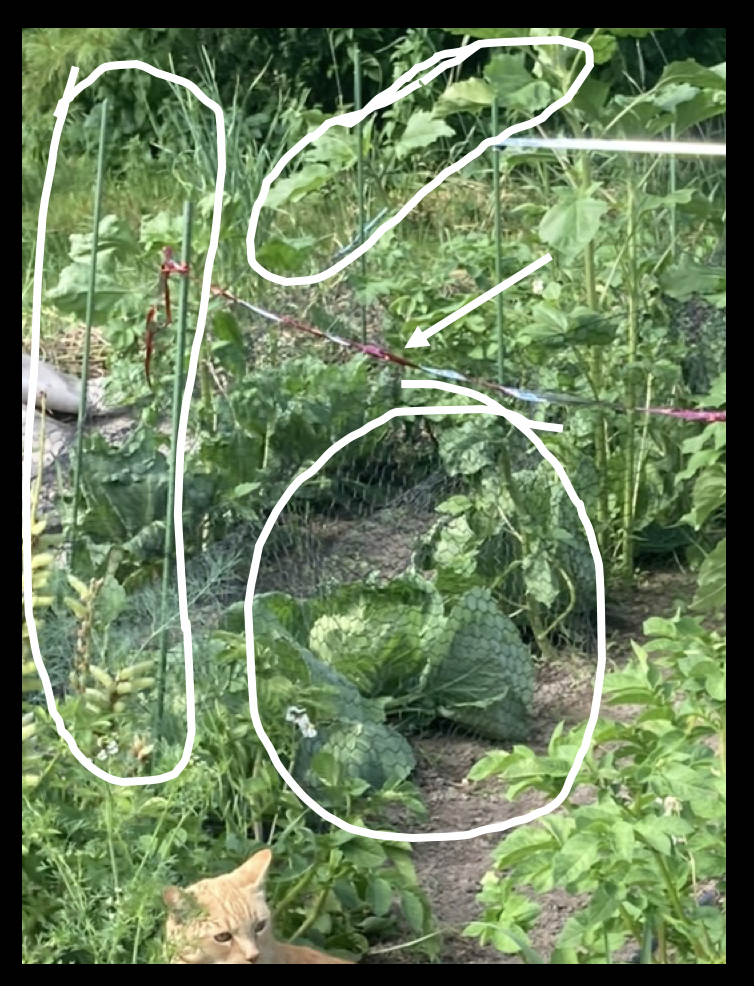
The photo left is an enlarged section of the one above. It shows part of two short rows of cabbage next to the carrot spot. For the cabbages, I again built minimally secured “tunnels” over them, also with 24” tall chicken wire. You can see one of the skinny metal stakes I used circled on the left hand side of the pic. If you look closely at the circled cabbage, you can see the chicken wire. The skinny circle toward the top that runs almost diagonal points out some young sunflowers, volunteers from last year’s plants that are going to get tall and gangly. I left them intentionally to create an inconvenience down the center of the two cabbage rows that deer wouldn’t likely bother to bother with. With the big sunflowers, the short fencing, and the sticks, the spot didn’t really attract walkers. Now, months later, I’ve got the cabbage fencing pulled off now, and the heads removed but the base of the plants left in the ground so the deer can finish them. They still haven’t stepped on the carrots.
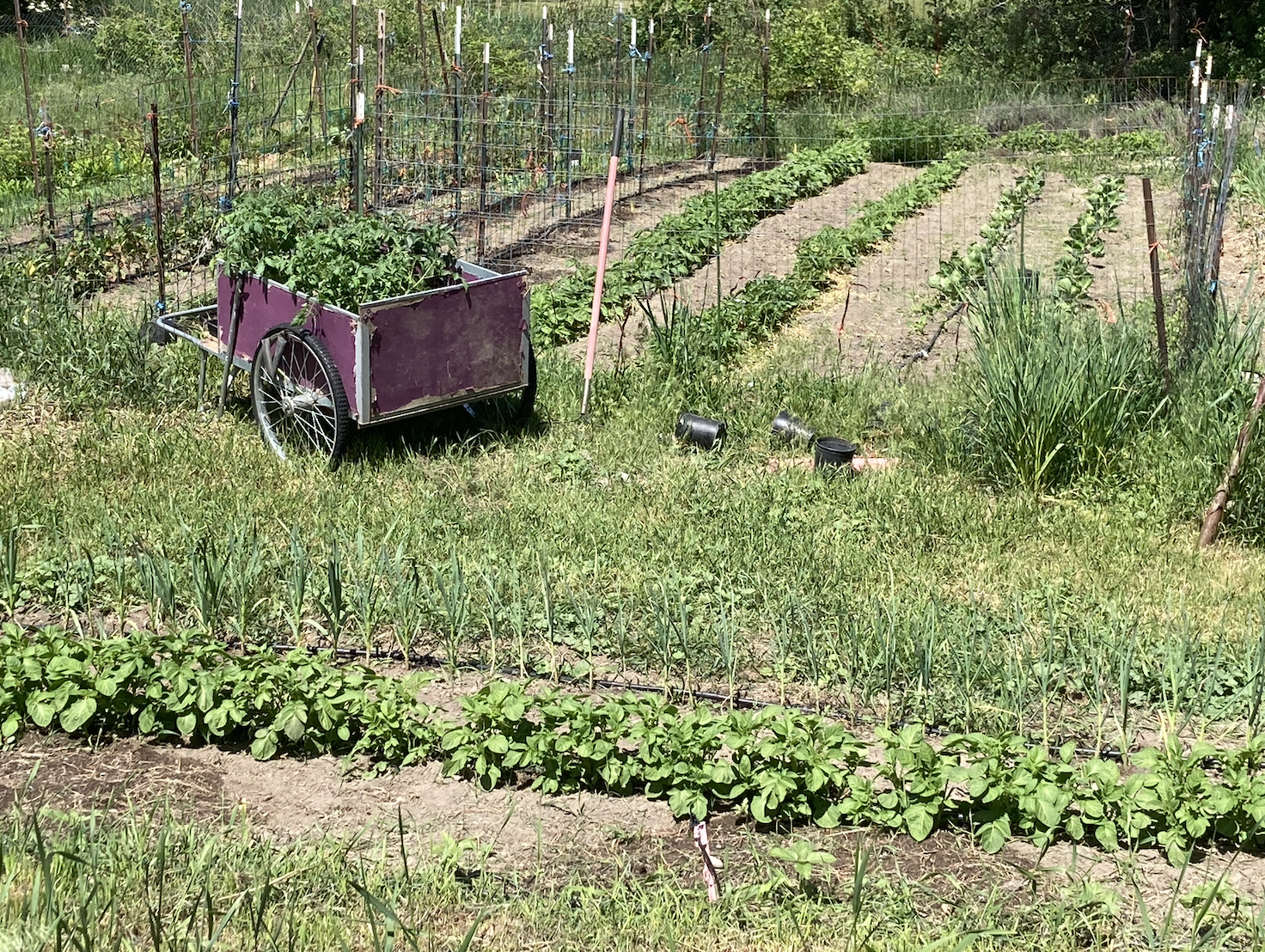
Another example of using plants to create “permeable fencing” centers around whether the deer like a plant or not. I tried a completely unprotected couple 30 foot long rows of potatoes and garlic because I didn’t think the deer would be particularly attracted to them. And they weren’t. Photo below shows part of the unfenced potato/garlic row in forefront. Brussels sprouts and more potatoes (hedging my bets on that “no fence” plot) are planted inside the permeable perimeter fencing. Tomatoes in purple wagon will be planted next to and tied to interior fencing as they grow.
On the outside of the south garden line (photo below) those red and white blooms from a previous photo grow into a dense row of perennial flowers outside the fence, dominated by Lupine and Sweat William, which it turns out deer also don’t particularly care for. I didn’t plan that, but I would have had if I’d known. This area also always has volunteer sunflowers, which I leave so they can “get in the way,” too.
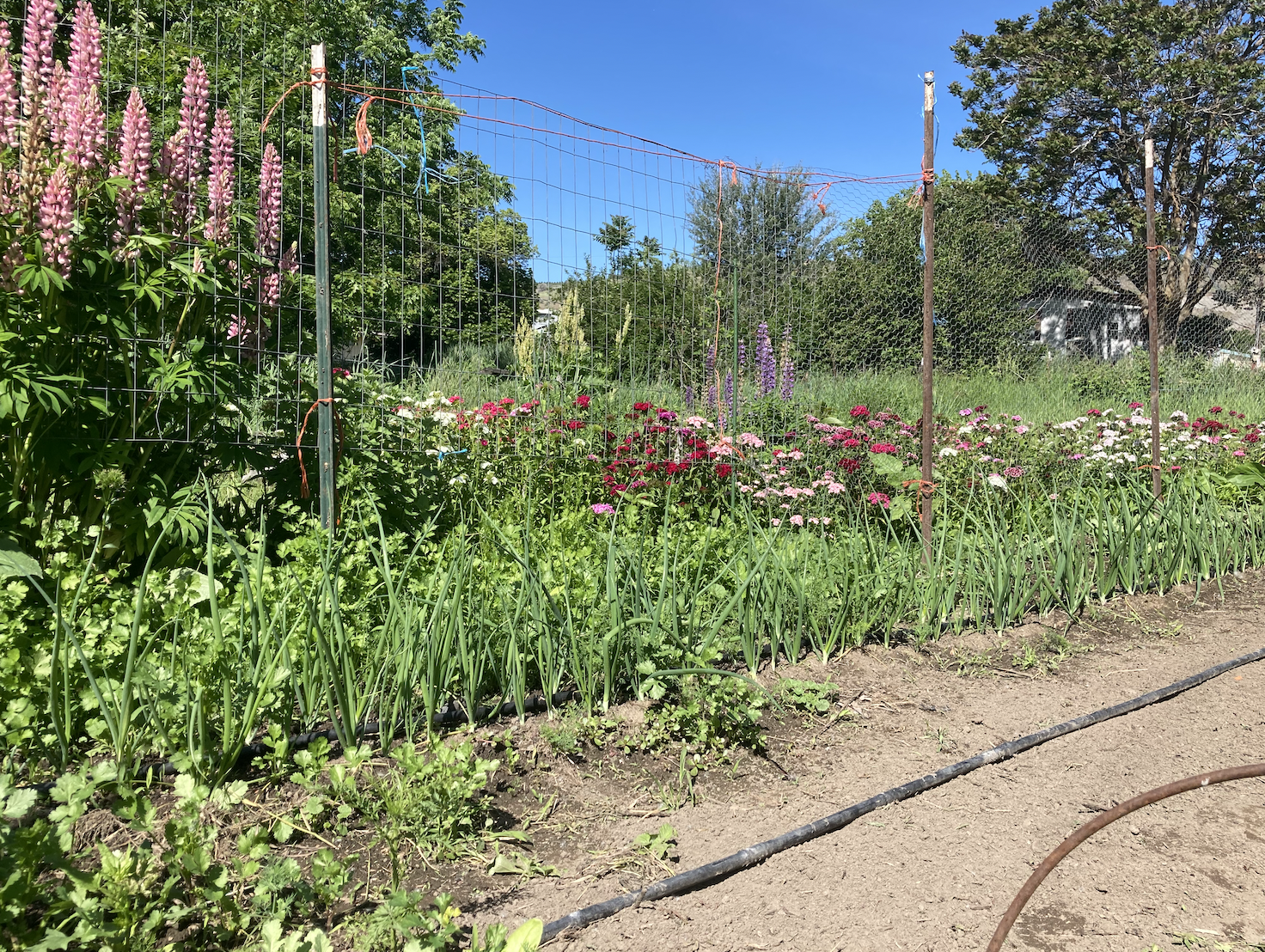
On the immediate inside of the garden fencing, I put less attractive deer food closest to the fence (like the onion row above) and keep their favorites (like peppers and green beans) in the center of the garden. There’s also usually some intentional (or maybe just lazy) use of allowing “weeds” in the garden at certain times. During the heat dome, for example, they helped keep the soil cooler. Maybe. But they also help obscure things from the deer.
“Hiding” Things
There’s one 8 foot section of fence on the front of the garden that’s a piece of fancy lattice, so you can’t see through it well. I’ve read that fencing that obscures the view of the ground the deer will need to land on can deter them a bit, and that angling a fence outward like a backslash can also confuse deer’s view of their landings. I’ve mentioned row cover material, but shade cloth can play a role, too. This year, I needed to use shade cloth to protect some plants, first from heavy rain and hail, and then from the heat on and off. It was white, about four feet wide, and when not in use, it hung over the outside of the north fence like a 40 foot long curtain. It more “steered” the deer than obscured things.
Inconvenience and Distraction
I also use flashy bird tape in spots, and whether or not it deters them, I know they see and hear it. I tied it into the cabbage / carrot plot and at the tops on some of the perimeter fencing. And I’ve grown to kind of like it. It makes little flashes of red and silver and some nice sounds.
Gardening with a few deer has gone pretty well with not too much additional workload. But it has required some adjustment of expectations. I had to accept letting a few things get nibbled, but tried to prevent fatal nibbling. I’ve happily turned the grapes over to the deer the last couple years, and they do help with vine management. If I pruned just lightly in early spring, the vines went nuts all summer and the deer took them back down to a nice level for winter. The final and best thing to do when gardening with the deer is simply check what they’re up to during peak feeding times: early morning and early evening.
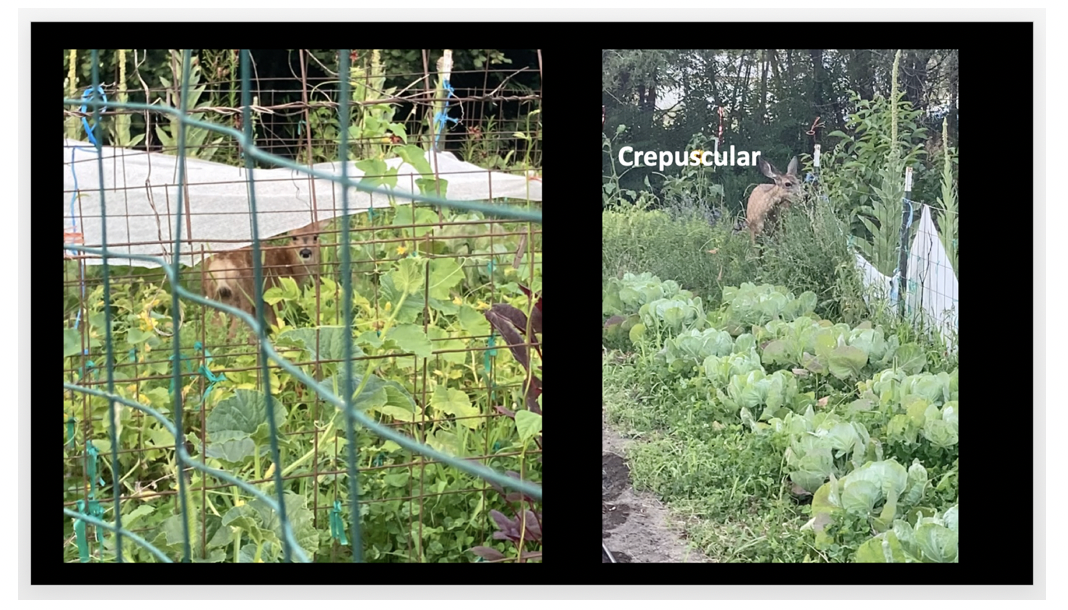
Crepuscular: A way to describe animals who are most active during “twilight” hours. More cool vocab: matutinal refers to early morning twilight times; vespertine to evening times. Deer are crepuscular creatures and both matutinal and vespertine. Hunters use this behavior to improve a hunt. I use it to keep an eye on what the deer are doing and to up the odds of encountering them.
The left photo above is of a young fawn who did get into the garden and explore. The fawn is on the far side of a couple internal row fences and she’s under some metallic shade cloth, which must’ve been pretty exciting because it shimmers in the sunlight. I spotted her when checking on the garden early one morning, and unfortunately, as soon as she saw me, she made her way through the internal fencing and bolted to her mother who was standing outside the garden at a corner. This was the exact wrong direction to go to get out. In this spot, the fencing goes all the way to the ground, and the fawn was too young to jump it at even the lowest point. It threw its little body at it a few times anyway before giving up.
I opened the gate and to nudge the fawn toward it, I walked around the outside of the garden toward the fawn and doe. I hoped to get close enough (without any drama) that the fawn would be unnerved, forget trying to reach its mother, and run the opposite way from where I was, which would be toward the open “gate.” It was, after all, what it was supposed to be learning from the mother at this stage of its life, to run away from trouble.
So I walked very slowly toward the doe and her distressed fawn. Impressively, mom let me come pretty close, though she didn’t take her eyes off me. There were no huffs or snorts. No little foot stamps. Once I got about 10 feet from them, the fawn bolted away from me down the Brussels Sprouts rows in the right hand picture. It found the partly open gate, sort of smashed through it, and ran around the fence to the doe. No harm no foul.
The deer here have been exceedingly polite so far. At the end of the garden year, I open up the fencing and let ’em have at it.

For much better info on living and gardening with wildlife, check out this WDFW handout:
Next: The West Path, the Paddocks, and the Patio
 mostlyjoy.com
Leave a comment