The Hephaestus Seasons
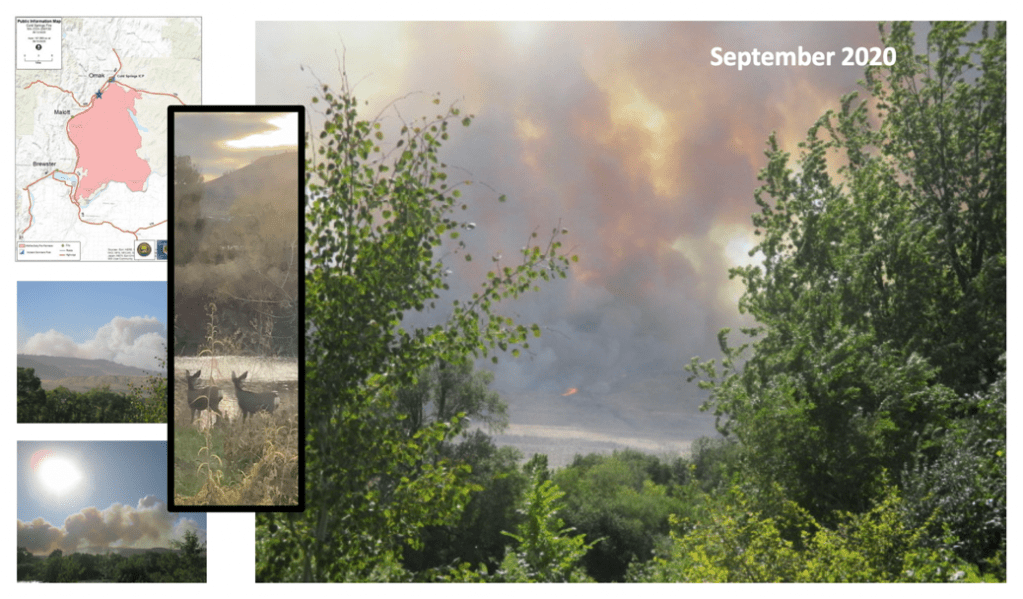
But it’s not all just fun and games with water. We do fire here, too. We’ve dealt with a regular fire season since 2014, but the first warning was really the Chelan County Tyee Creek Fire in 1994. Fire season is a miserable, high-impact experience. It decimated almost a million acres in Okanogan County in 2015 alone, including nearly a quarter million acres that burned on the Colville Reservation. The photos above are views from my back yard of the 2020 Cold Springs/Pearl Hill fire. In the skinny photo with the fawns, they’re on the bank in my yard looking in the exact direction of the fire had it been there when that photo was taken, which it was not. The large photo is taken from that same spot the fawns stand in.
The fire started across the river north of me, and within roughly 6 hours had ripped 20 miles south to the Columbia River, which it then jumped and continued burning, temporarily preventing the evacuation of a tiny town called Mansfield in its path. Over 400,000 acres burned. Utilities were down for people in its swath for more than a month. It was wind that did that. Corner insert is a public info map of the Cold Spring fire. The Elmway neighborhood is just a spit north of the star on that map. Online state agency and media records show 12 human fire deaths here from 2000 – 2022. One of those occurred during the Cold Spring Fire.
The 2014 fires (300,000 acres) were smaller in acreage but destroyed 300 homes, killed about 4000 cattle, and burned hundreds of tons of hay needed for surviving cattle. Vegetation supporting deer’s food and shelter needs was gone as well, putting the deer and other wildlife at risk of population impacts and pushing deer toward unburned agricultural lands and risk of conflict with ranchers trying to protect that remaining feed. An estimated 11,000 deer were left struggling by 2015.*
*Jon Wyss, Executive Director USDA Farm Service Agency (FSA) in Washington State. https://www.krem.com/article/news/local/okanogan-county/wildfires-leave-okanogan-co-wildlife-hungry/293-45064888
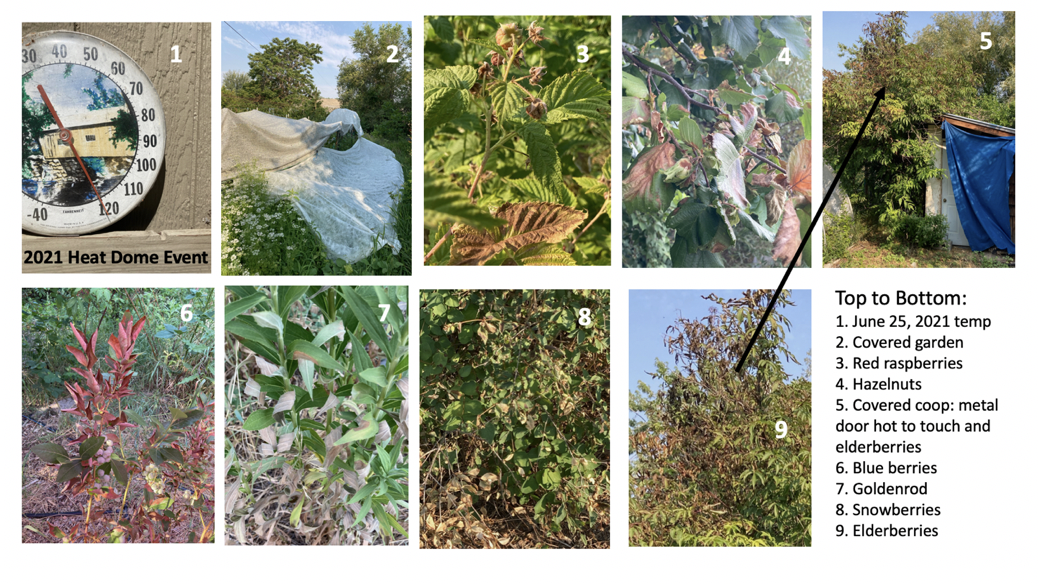
While we didn’t burn extensively in 2021, we were smacked by the so-called Pacific Northwest Heat “Dome.” But I refuse to call it a dome. It was a heat event. It was an extreme weather event, a reminder that weather can exceed our expectations.
The summer as a whole was pretty warm, but the heat event per se was only about two weeks long, peaking on June 29 where I live at an official 117 degrees but definitely hitting 120 on the river even before the peak temperature. Plenty of us sat through it without A.C., but it was a heavy lift. And in those two weeks, the destruction to plants was notable. Plants, aka what deer eat, aka what people eat. One vulnerability was the timing. It was only a few days into “official” summer when the heat hit, and many things were still young and spring tender.
In 2022, instead of an early season roasting, we had a long, cool, wet spring and then a series of short but constant rolling heat waves that easily hit 105 – 110. Someone on Twitter asked whether people were finding 2022’s extended heat or the 2021 heat dome “worse” to deal with. I looked up the pics above and concluded that 2021 was worse. But I was wrong.
As time went on in the 2022 heat, scorch appeared on the same plants. But worse, I watched those rolling heat waves impact pollen all summer. Potatoes and carrots did fine, but everything growing above ground suffered some level of low “set.” Tomatoes, which grow basically like weeds here, were barely productive. I watched blooms fall off with each little heat wave as the triple digit temps desiccated the the pollen and the blooms’ reproductive parts. Every time the plants produced new blossoms, heat picked up and zapped them again. Peppers were similarly impacted, as were— believe it or not— heat loving green beans.
As I write this, it’s mid-October 2022 and we’re sitting in 80 degree days with 50 degree overnight temps. It’s ridiculously warm. I’ve more commonly seen frost and freeze if not light snow by mid-October on this place. When my kids were small, Halloween was a notoriously cold event. But this year, the tomatoes are finally starting to ripen and the beans have decided to kick in.
My Human Use of Water
Water has been essential to dealing with both heat and fires. Fires have passed by closely enough that people in Elmway monitored property for burning embers and most had sprinkler set ups ready to go or going. During 2015, water from a sprinkler running on the front porch roof unexpectedly created a sort air filter. The house was shut tight against the smoke for days and air inside it was “tolerable,” but the air on the water-enclosed porch was actually fresh. We’re exceedingly dry here. During summer 2022, we hit 4% humidity at one point, which shouldn’t even be a thing. But the arid nature of this area allows us to use water in cooling, unlike places on the west side of the state where humidity contributes to the pain.
Most irrigation on this place is drip line, but there are a few overhead rain birds and a few micro-sprinklers. During the heat waves, I timed irrigation for the cooling needs of different areas on the property, for example, watering the areas animals used so they’d be at their coolest during the hottest part of the day. Desperate to see blooms set, later in the summer I ran an overhead lawn sprinkler intermittently in the garden. It definitely pleased the above ground parts of the plants, but it also compacted the soil pretty quickly, which did not please the underground parts of the plans. And using water to cool the air where you’re trying to grow food in a northern desert is borderline evil, but here we are this year and last. As a human, I’m feeling a bit pummeled by this environmental chaos, and it deepens both my respect for the capacity of wild creatures to survive a life where they are the place where they are, and my awareness of the stressors they face in doing so.
This concludes the doom and gloom section of the three-legged deer project.
 mostlyjoy.com
Leave a comment