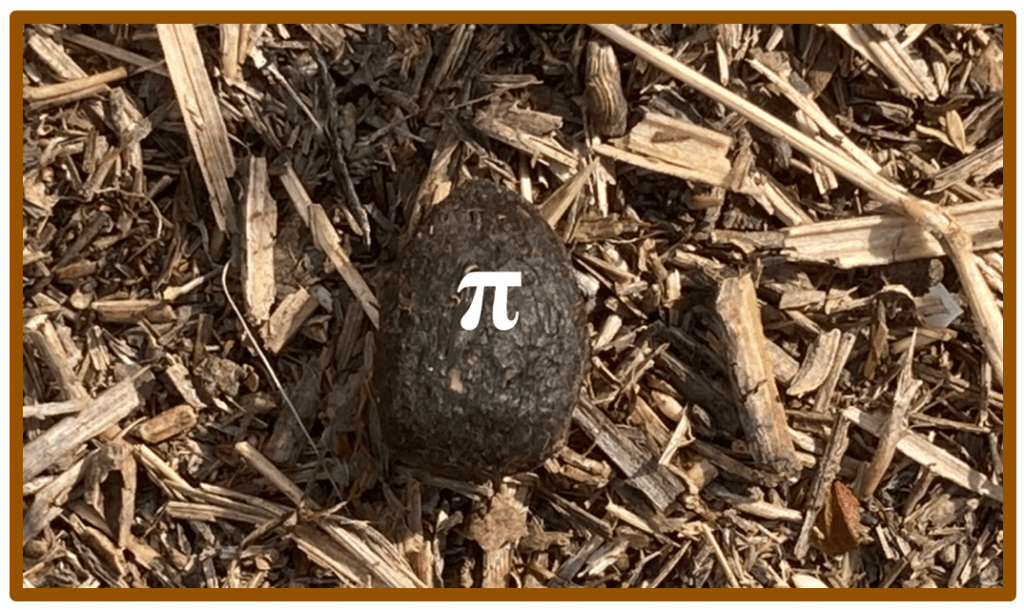
Here’s what happened.
I’ve lived, gardened, and raised some fruit and some kids on a 1.5 acre piece of property on the Okanogan River for 26 years. For 23 of those years, there was certainly a deer here and there along the river, but no real encounters on the property. Through 2016 and 2017, this general area experienced an unsustainably elevated skunk population. I tried briefly to accommodate them, but that’s just not possible on small acreage. The single skunk I first encountered was a small female, and we did fine coexisting the summer she showed up, but come fall, she tried to invite her sisters and aunts and girlfriends and I don’t know who all else to den up with her under a porch for a winter. Basically, she tried to start a skunk brothel. That’s a no. It inspired me to get more strategic about “curating” how this property is and is not welcoming to the wildlife along the river. Nothing’s really fenced, although there is some fencing. I’m talking out-building fixes, managing trees, shrubs, forage, corridors, and such. For example, we cleared a small vine-covered area that hid an old wooden culvert we discovered skunks were using to slip through a field and onto the property unseen.
Humans: 1; Skunks: 0.
In spring 2018, we got unexpected help with the skunk population when the river flooded, and in 2019 came the ungulata, the hooved animals. In 2019, the first of the does began to visit (pic below with the red outline). My son and I unexpectedly encountered some stage of a rut on the property in fall 2019, as well, walking around a line of shrubs to find a doe and buck lying on the ground breathing in a labored manner and putting off a distinctly intense vibe.
The photos below are the actual does and bucks who have so far spent time here or passed through. The bucks are pretty elusive. I was surprised I even had a some of the buck photos, and out of hundreds of pics, these are the only ones in which bucks appear. I can decipher the relationships between the does and fawns, but I’m clueless about the bucks’ ages or their relationships to each other or the does.
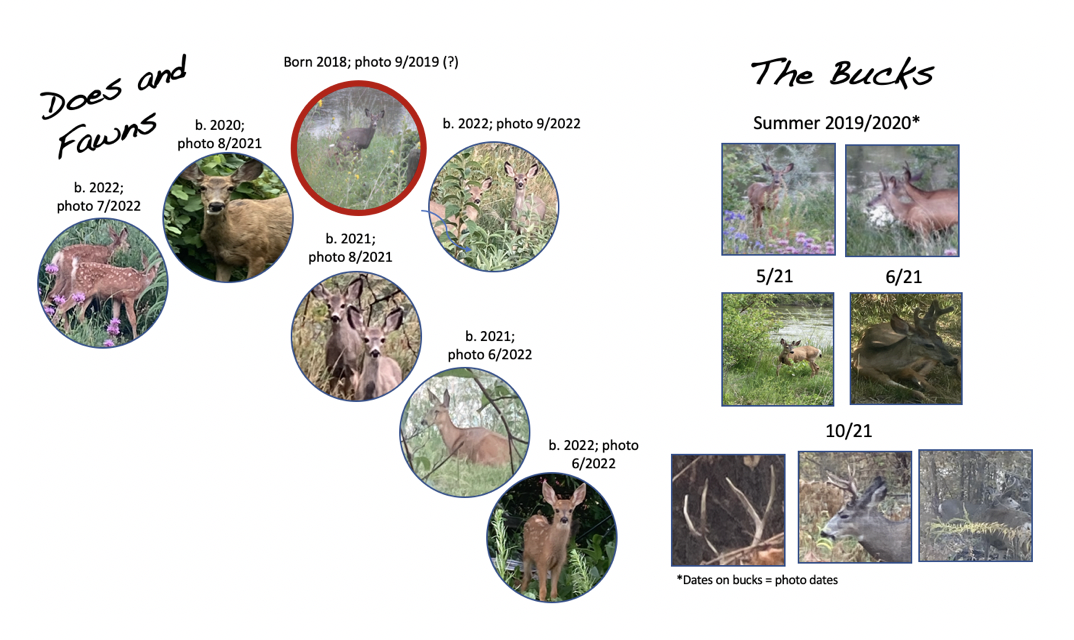
So. During 2019, I noticed a specific doe becoming a frequent visitor. In 2020, I started watching for her intentionally. By 2021, I was pretty engrossed. During 2021 and 2022, this first doe— and what I believe are two of her daughters— all brought fawns to the property, one as a day old fawn that spent its first five weeks here. Sometimes they were present as individual mom/fawn units, and sometimes together as multiple units. And the main reason I can track the relationships is because this oldest, initial doe who brought fawns here only has three and a half legs. No GPS collars or ear tags needed to identify her. When writing or drafting in other media for this “project,” I tend to think of her as The O.G., but when I’m just encountering her or watching her, I usually call her something like “oh-good-there’s-the-three-legged-doe-still-alive.” It’s a conundrum. I’m not interested in “naming” these deer, but I need language so I can refer to them clearly. Things like “oh, that’s that doe” don’t work in writing. But if you’re going to slap a name on a wild animal, it seems like you ought to try to do it well.
In trying to figure out what to call the three-legged doe, I’m embarrassed to admit Tripod immediately came to mind. So did a few other bad ideas. Finally I thought of Pi. Pi as in circumference divided by diameter, Pi as in circles and such. Pi is a window, a frame. Something you can look through to better see some other things— their shape, their size, what they can do or be. It’s also the infinite decimal 3.14159…, which is respectfully snarky but not tacky like Tripod. So while I don’t really call her “Pi” in my head, I use “Pi” in these notes in spots, both the word and the symbol (π). Similarly, there are two other doe who “need names.” We’ll get to that, but to start, I’m going to start with the place.
First Up: The Geopolitical Place
 mostlyjoy.com
Leave a comment